Speed Skating – Long Track
Team Canada Medal Count
 11
11
 17
17
 19
19
Sport Details

NSO Channels




Sport Overview
Long Track Speed Skating at Milano Cortina 2026
Venue: Milano Speed Skating Stadium
Competition Dates: February 7-9, 11-15, 17, 19-21 (Days 1-3, 5-9, 11, 13-15)
Events: 14 (7 men, 7 women)
| Men’s Events | Women’s Events |
|---|---|
| Men’s 500m Men’s 1000m Men’s 1500m Men’s 5000m Men’s 10,000m Men’s Mass Start Men’s Team Pursuit | Women’s 500m Women’s 1000m Women’s 1500m Women’s 3000m Women’s 5000m Women’s Mass Start Women’s Team Pursuit |
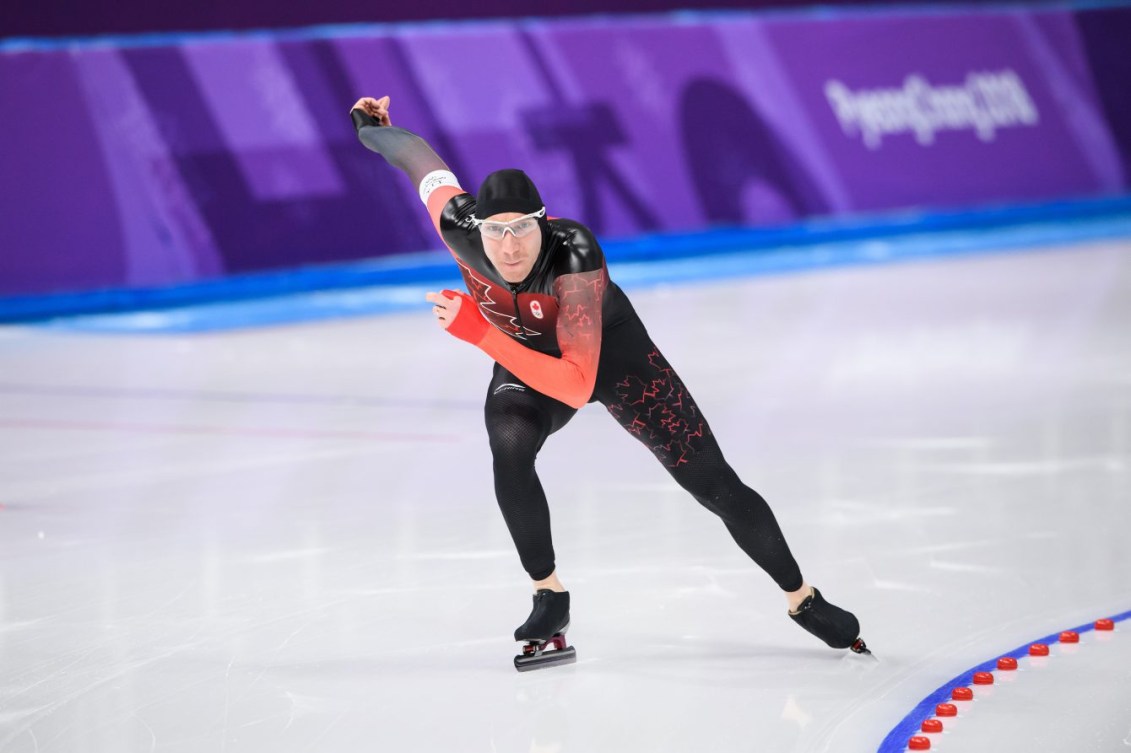
Long track speed skating is considered the fastest human-powered sport in the Olympic Games, with skaters reaching speeds of more than 60 km/hr. All long track speed skating events take place on a 400m oval and are timed to the hundredth of a second (0.01).
In the individual distance events, skaters race in pairs against the clock. Skating counterclockwise around the oval, the skaters change lanes once per lap to equalize the distance covered. The skater in the outside lane has the right-of-way if the two skaters arrive at the crossover point at the same time. Men and women both compete in the 500m (1 ¼ laps), 1000m (2 ½ laps), 1500m (3 ¾ laps) and 5000m (12 ½ laps). The women also have a 3000m (7 ½ laps) race while the men have a 10,000m (25 laps) race.
In the men’s and women’s mass start events, skaters cover 16 laps of the oval. As the name implies, all competitors are on the ice at one time. During the race there are three intermediate sprints (after four, eight and 12 laps) for which skaters are awarded points (three for first, two for second, one for third) that count towards the final standings. The final sprint to the finish awards 60 points for first, 40 points for second, and 20 points for third, ensuring that the first three skaters to complete the 16 laps are also ranked as the top three in the race results.
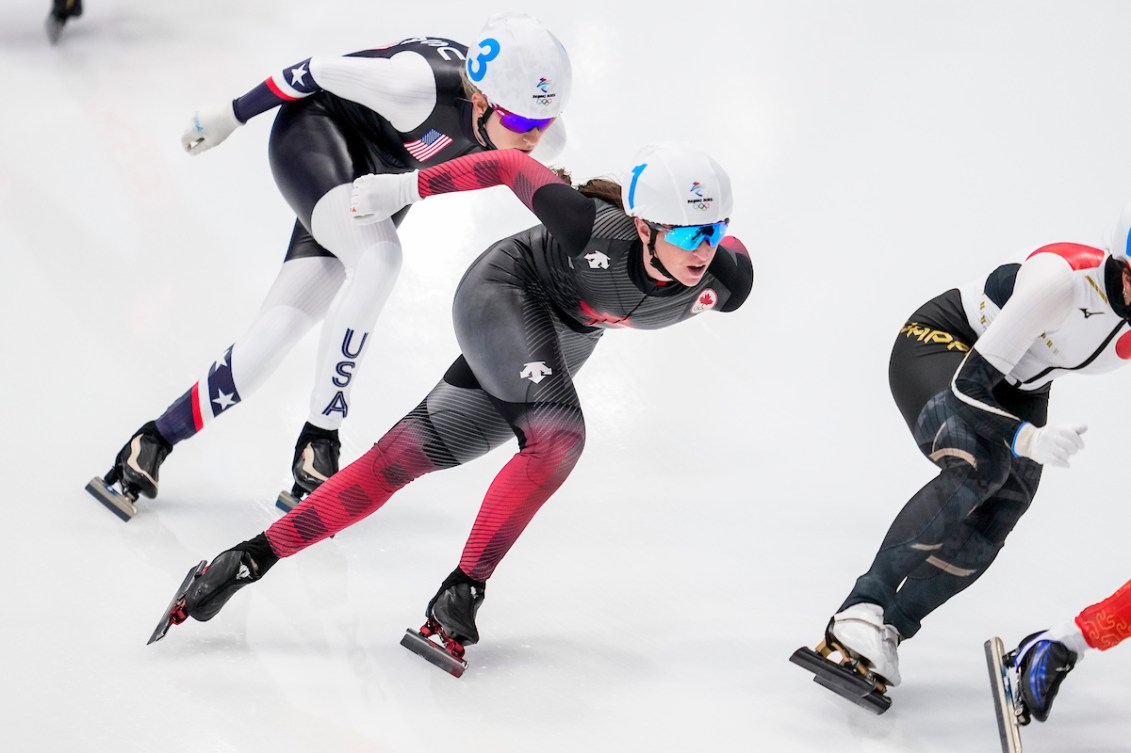
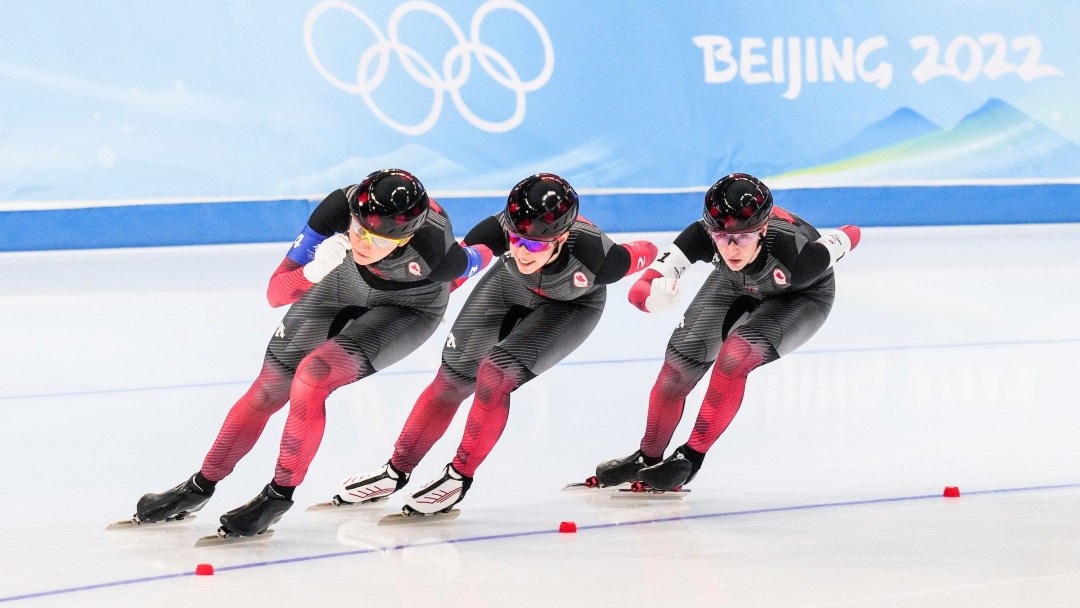
The men’s team pursuit event covers eight laps of the oval while the women’s team pursuit event covers six laps. Two teams of three skaters begin simultaneously on opposite sides of the oval. Team members take turns leading with the other skaters following closely behind to take advantage of drafting. The team completes the race when all three members have crossed the finish line. Olympic competition begins with the quarterfinals, held in a time trial format. The four teams with the best times advance to the semifinals where the fastest team faces the fourth-fastest and the second-fastest team faces the third-fastest. Semifinal winners compete for gold and silver, while semifinal losers compete for bronze.
Canadian Olympic Long Track Speed Skating History (Pre-Milano Cortina 2026 )
Canadian long track speed skaters have won 42 Olympic medals, the country’s greatest total in any winter sport.
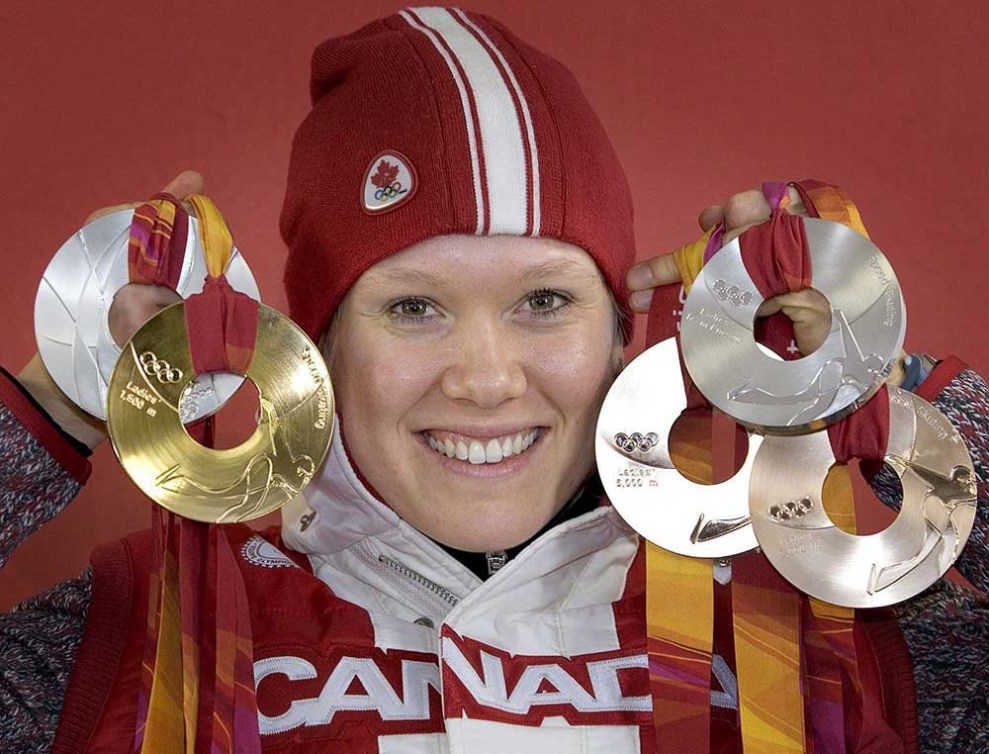
Tied as Canada’s most decorated Winter Olympian is Cindy Klassen, who won six medals in her career, including a remarkable five at Turin 2006—the most by any Canadian athlete at one Olympic Games. Her 3000m bronze at Salt Lake City 2002 only foreshadowed what was to come four years later when she won gold in the 1500m, silver in the 1000m and team pursuit, and bronze in the 3000m and 5000m.
Dual sport Olympian Clara Hughes won four of her six medals in long track speed skating. She began with 5000m bronze at Salt Lake City 2002 before winning gold in that event at Turin 2006 where she also won silver with the team pursuit. She won another 5000m bronze at Vancouver 2010.
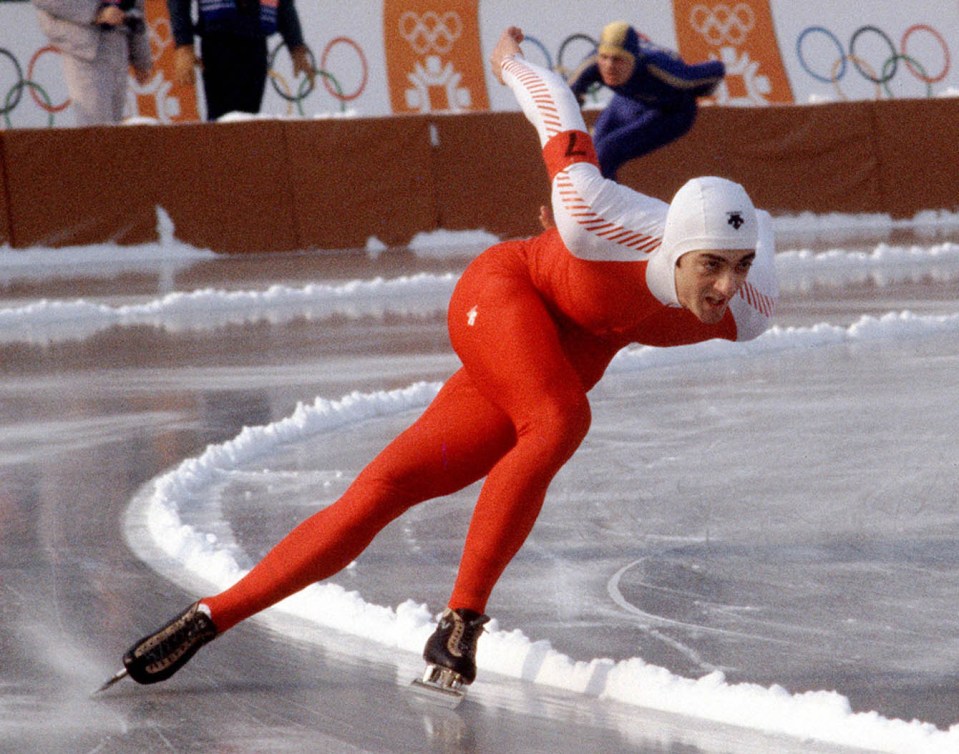
Canada has three other quadruple medallists in long track speed skating. Gaétan Boucher was a double gold medallist at Sarajevo 1984 in the 1000m and 1500m where he also won bronze in the 500m. He added those to the 1000m silver he won at Lake Placid 1980. Kristina Groves won two silver medals at Turin 2006 in the 1500m and team pursuit. She added another 1500m silver and a 3000m bronze at Vancouver 2010.
Denny Morrison was the only Canadian to win medals on the big oval at Sochi 2014, first capturing silver in the 1000m followed by bronze in the 1500m. Morrison was only able to compete in the 1000m after teammate Gilmore Junio relinquished his spot in the event, feeling that Morrison had the better shot at a medal. Morrison previously won team pursuit gold at Vancouver 2010 (with Lucas Makowsky and Mathieu Giroux) and team pursuit silver at Turin 2006.
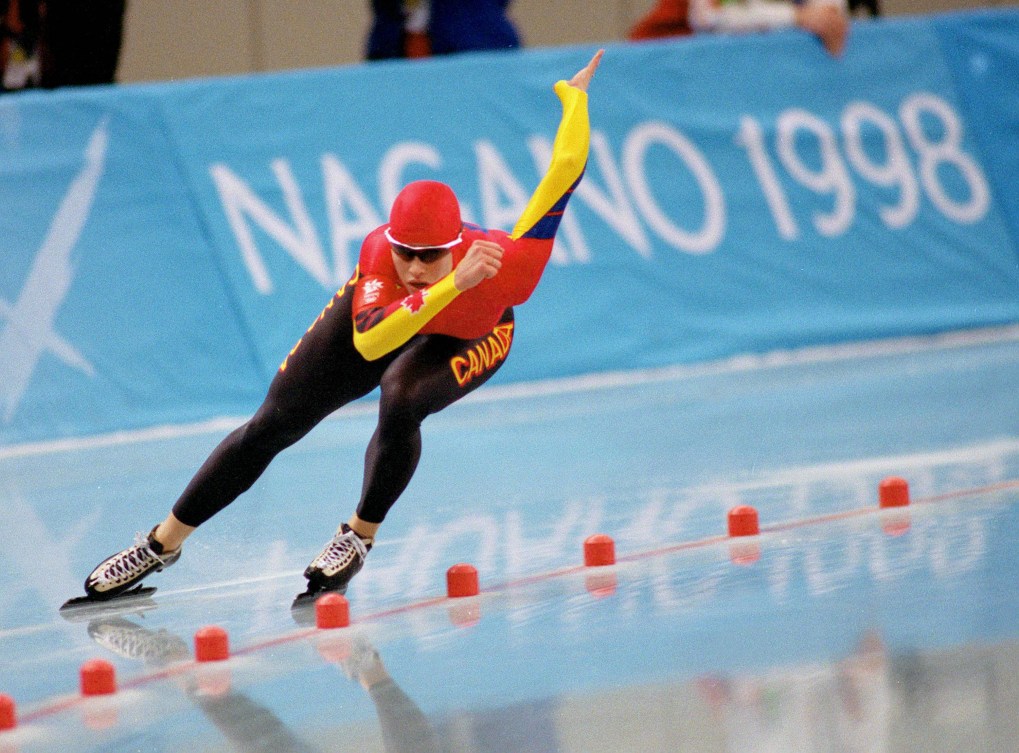
The only skater since Boucher to win two Olympic gold medals is Catriona Le May Doan, who won 500m gold at Nagano 1998 and Salt Lake City 2002 to make her the first Canadian athlete to successfully defend an individual Olympic gold medal. She also won 1000m bronze in Nagano.
Ted-Jan Bloemen added two medals to Canada’s total at PyeongChang 2018. He won 10,000m gold in Olympic record time after winning 5000m silver in a photo finish. He ended an 86-year Olympic medal drought for Canada in both events. Rounding out Canada’s gold medallists is Christine Nesbitt who won the 1000m at Vancouver 2010.
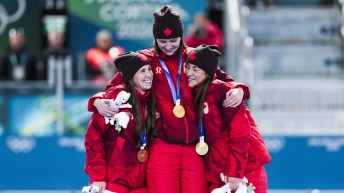
Isabelle Weidemann was a triple medallist at Beijing 2022, winning gold in the team pursuit alongside Ivanie Blondin and Valérie Maltais after capturing 5000m silver and 3000m bronze. Blondin also earned Canada’s first ever Olympic medal in the mass start, taking silver. Laurent Dubreuil skated to silver in the men’s 1000m at Beijing 2022.
The first Olympic success for Canadian long track speed skaters was at Lake Placid 1932 where five medals were won. Alex Hurd and Willy Logan shared the podium in the 1500m with their 2-3 finish. Hurd added a bronze in the 500m while Logan also won bronze in the 5000m. Frank Stack was the 10,000m bronze medallist. Between then and Boucher’s breakthrough, Canada won just two medals: Gordon Audley’s 500m bronze at Oslo 1952 and Cathy Priestner’s 500m silver at Innsbruck 1976.
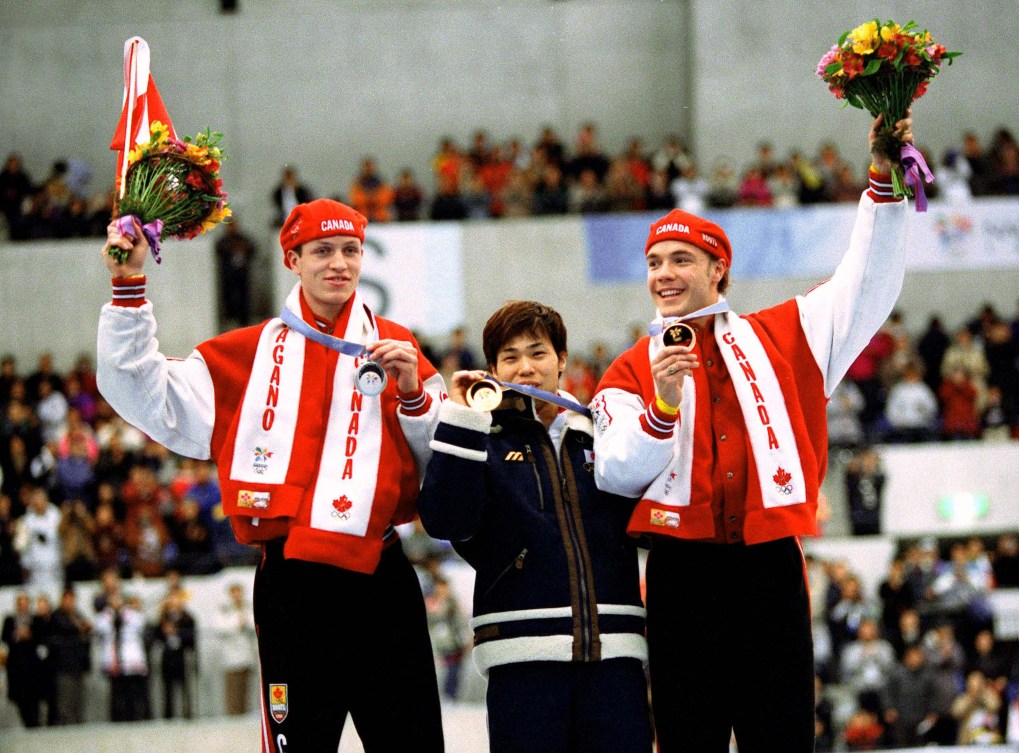
The 500m proved to be one of Canada’s strengths. Susan Auch won back-to-back silvers at Lillehammer 1994 and Nagano 1998, sharing the podium with Le May Doan at the latter. Also sharing a 500m podium in Nagano were silver and bronze medallists Jeremy Wotherspoon and Kevin Overland (Crockett).
Olympic Speed Skating History
Speed skating has been included at every Olympic Winter Games dating back to the first edition at Chamonix 1924. Women’s events were first included as a demonstration sport at Lake Placid 1932, but it wasn’t until Squaw Valley 1960 that women’s speed skating events gained official Olympic status.
Lake Placid 1932 were the only Olympic Games at which the competition format differed from the typical time trial pairings. Instead, the events were contested as pack style races, similar to that seen in modern day short track speed skating.
Men have always competed in 500m, 1500m, 5000m, and 10,000m. The 1000m event was added at Innsbruck 1976.
The first Olympic events for women were the 500m, 1000m, 1500m, and 3000m. The 5000m event was added at Calgary 1988.
The men’s and women’s team pursuit events were first featured at Turin 2006. The men’s and women’s mass start events were added at Pyeong Chang 2018, marking the return of pack style racing in Olympic long track speed skating.
Canadian Medallists
| Games | Event | Athlete | Finish |
|---|---|---|---|
| Sarajevo 1984 | Men's 1000m | Gaétan Boucher | Gold |
| Sarajevo 1984 | Men's 1500m | Gaétan Boucher | Gold |
| Nagano 1998 | Women's 500m | Catriona Le May Doan | Gold |
| Salt Lake City 2002 | Women's 500m | Catriona Le May Doan | Gold |
| Turin 2006 | Women's 1500m | Cindy Klassen | Gold |
| Turin 2006 | Women's 5000m | Clara Hughes | Gold |
| Vancouver 2010 | Women's 1000m | Christine Nesbitt | Gold |
| Vancouver 2010 | Men's Team Pursuit | Denny Morrison, Lucas Makowsky, Mathieu Giroux | Gold |
| PyeongChang 2018 | Men's 10,000m | Ted-Jan Bloemen | Gold |
| Beijing 2022 | Women's Team Pursuit | Ivanie Blondin, Valérie Maltais, Isabelle Weidemann | Gold |
| Lake Placid 1932 | Men's 1500m | Alexander Hurd | Silver |
| Innsbruck 1976 | Women's 500m | Cathy Priestner | Silver |
| Lake Placid 1980 | Men's 1000m | Gaétan Boucher | Silver |
| Lillehammer 1994 | Women's 500m | Susan Auch | Silver |
| Nagano 1998 | Women's 500m | Susan Auch | Silver |
| Nagano 1998 | Men's 500m | Jeremy Wotherspoon | Silver |
| Turin 2006 | Women's 1000m | Cindy Klassen | Silver |
| Turin 2006 | Women's 1500m | Kristina Groves | Silver |
| Turin 2006 | Men's Team Pursuit | Arne Dankers, Steven Elm, Denny Morrison, Jason Parker, Justin Warsylewicz | Silver |
| Turin 2006 | Women's Team Pursuit | Kristina Groves, Clara Hughes, Cindy Klassen, Christine Nesbitt, Shannon Rempel | Silver |
| Vancouver 2010 | Women's 1500m | Kristina Groves | Silver |
| Sochi 2014 | Men's 1000m | Denny Morrison | Silver |
| PyeongChang 2018 | Men's 5000m | Ted-Jan Bloemen | Silver |
| Beijing 2022 | Women's 5000m | Isabelle Weidemann | Silver |
| Beijing 2022 | Men's 1000m | Laurent Dubreuil | Silver |
| Beijing 2022 | Women's Mass Start | Ivanie Blondin | Silver |
| Lake Placid 1932 | Men's 500m | Alexander Hurd | Bronze |
| Lake Placid 1932 | Men's 1000m | William Logan | Bronze |
| Lake Placid 1932 | Men's 5000m | William Logan | Bronze |
| Lake Placid 1932 | Men's 10,000m | Frank Stack | Bronze |
| Oslo 1952 | Men's 500m | Gordon Audley | Bronze |
| Sarajevo 1984 | Men's 500m | Gaétan Boucher | Bronze |
| Nagano 1998 | Men's 500m | Kevin Overland (Crockett) | Bronze |
| Nagano 1998 | Women's 1000m | Catriona Le May Doan | Bronze |
| Salt Lake City 2002 | Women's 3000m | Cindy Klassen | Bronze |
| Salt Lake City 2002 | Women's 5000m | Clara Hughes | Bronze |
| Turin 2006 | Women's 3000m | Cindy Klassen | Bronze |
| Turin 2006 | Women's 5000m | Cindy Klassen | Bronze |
| Vancouver 2010 | Women's 3000m | Kristina Groves | Bronze |
| Vancouver 2010 | Women's 5000m | Clara Hughes | Bronze |
| Sochi 2014 | Men's 1500m | Denny Morrison | Bronze |
| Beijing 2022 | Women's 3000m | Isabelle Weidemann | Bronze |
| Milano Cortina 2026 | Women's 3000m | Valérie Maltais | Bronze |
| Milano Cortina 2026 | Men's 500m | Laurent Dubreuil | Bronze |
| Milano Cortina 2026 | Women's Team Pursuit | Ivanie Blondin, Valérie Maltais, Isabelle Weidemann | Gold |
| Milano Cortina 2026 | Womens' 1500m | Valérie Maltais | Bronze |
| Milano Cortina 2026 | Women's Mass Start | Ivanie Blondin | Silver |