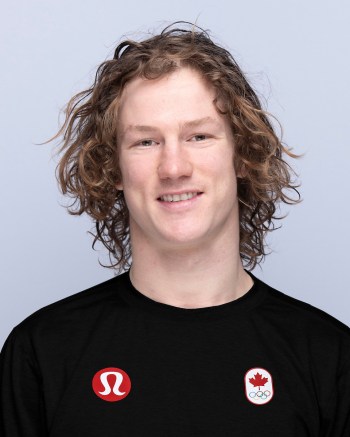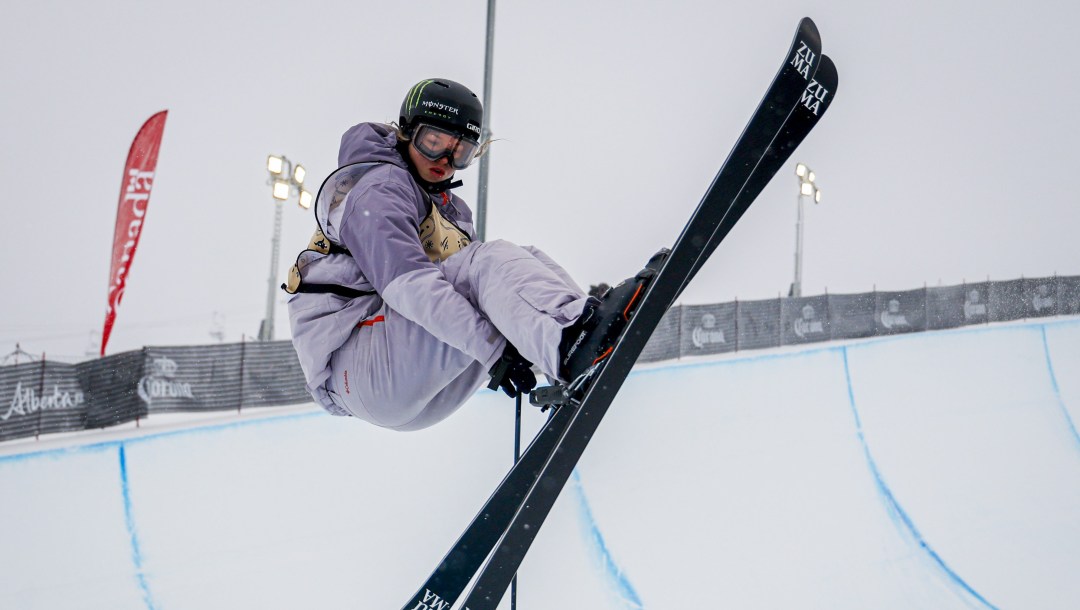
Halfpipe skier Cassie Sharpe is ready for a wild ride towards Milano Cortina 2026

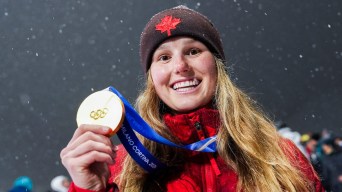
Team Canada halfpipe skier Cassie Sharpe wasn’t sure what to expect when she returned to competition after becoming a mom. She had even considered the possibility of retirement when she first got pregnant.
But the two-time Olympic medallist (gold at PyeongChang 2018, silver at Beijing 2022) didn’t feel like she was quite done in the halfpipe.
Over the course of the 2024-25 season, with the help of her support squad, Sharpe got to show her daughter Louella what her mom is capable of on skis. And that included some big results: a World Cup podium at Copper Mountain, an X Games gold medal in Aspen (the first mother to ever win one!), and a bronze medal at the FIS World Championships.
Olympic.ca chatted with Sharpe to reflect on last season, how halfpipe skiing has developed over the last decade, and some surprising changes to her competition routine since becoming a mom.
You took bronze at the 2025 World Championships—what did it mean to you to have that result in your comeback season?
CS: It was challenging coming back into the season, not really knowing where I would rank with being gone for two years. I had a couple challenging results in the middle of the year, with some good results. It was such a mixed bag.
I was trying out a new trick at the world championships. It did not go well my first run, so I pivoted for my second run and was like, “I don’t really know how this is going to go, but let’s give it a shot!” and it placed me on the podium. Then I got bumped down to third from the silver position, but I was still so stoked on that.
It was a really, really good way to end the year after having a bit of an up and down season. It was just like: “Okay, you’re okay, everything’s fine. Let’s fix up some stuff and be ready for the big year coming up.”
READ: “It takes a village”: Olympic medallist Cassie Sharpe returns to competition after becoming a mom
How much have you seen ski halfpipe, especially on the women’s side, progress since the sport made its Olympic debut in 2014?
I watched the Sochi 2014 Olympics and it was, to be fair, challenging for them. It was raining, it was slow, it was at night—really challenging conditions for them to be competing in. But even from then ‘til now the girls are going way bigger. All the girls are grabbing their tricks, which wasn’t a front-of-mind thing at the time.
And everybody is doing big tricks—the top eight girls are kind of interchangeable on any day. It’s who’s going the biggest, who’s grabbing their tricks the best. That’s a really cool thing to see that there’s so much talent in the sport that it’s just moving quickly.
What’s going through your head right before you compete?
Before I had Lou, I’d get nervous. But after having Lou, I don’t know if anything, like, hormonal has changed in my body, but I get so nervous! I cannot think, I cannot eat, I’ve thrown up a couple times at the top of the pipe. It’s bad. It’s so weird. And I don’t know why, because I still have the same teams, we still work on the same things. It’s kind of crazy.
But immediately before a contest. I just plug music in and go into my flow state where I tune everybody out, tune everything out, and just try to just stay focused on nothing until I’m in the start gate, and then I lock into my run.
For Team Canada fans that aren’t super familiar with ski halfpipe, how does the scoring work? What are the judges looking for?
For ski halfpipe, there’s a breakdown of categories and then an overall scoring system [with every run scored out of 100]. They’re looking for amplitude. They’re looking for a degree of difficulty. They’re looking for variation in your tricks. And then kind of the overall feeling of the run.
So you’ll see a lot of riders riding backwards through the pipe, and that adds another degree of difficulty. The bigger the spin, the harder it is. So when you see someone flipping and spinning, it’s harder than spinning upright.
Everybody’s run is completely different because it’s all different pieces and how you think that’s going to score.
How would you describe your skiing style?
I really like flipping. I like being upside down, so I don’t do a lot of my run upright. My signature trick is my back-to-back cork nines. So I feel like I lean towards doing my cork nines more than kind of anything else.