Ski Cross 101 with Team Canada’s Fastest and Fiercest

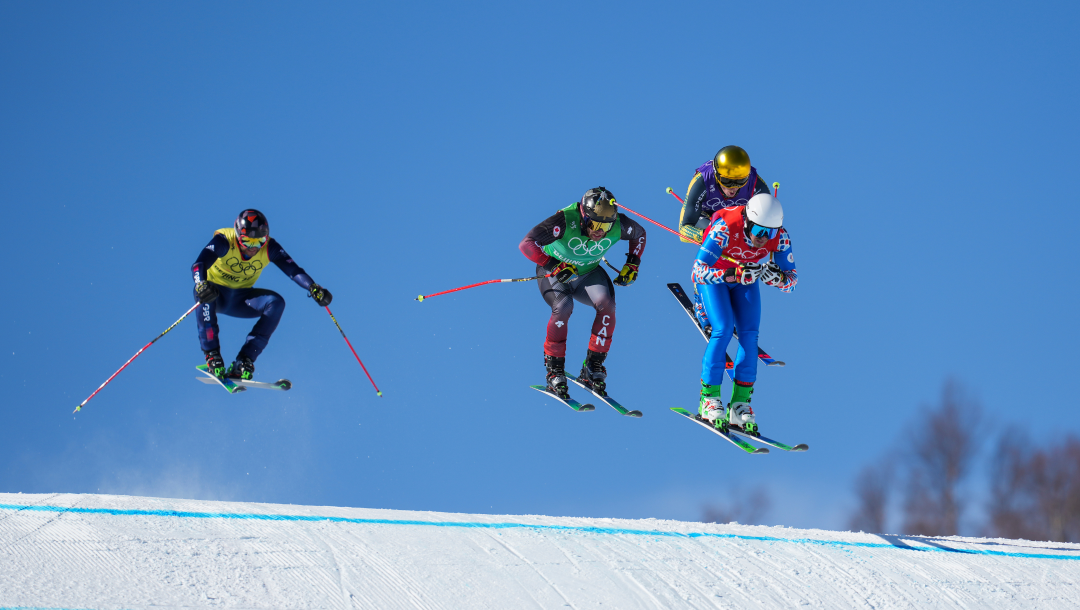
Extreme speed, gravity-defying jumps, and a whole lot of courage are all key elements of a ski cross competition.
This exhilarating discipline made its Olympic debut at Vancouver 2010, where Canadian Ashleigh McIvor took home the inaugural women’s gold medal. Since then, Team Canada has earned six more Olympic medals in ski cross and has never missed the Olympic podium in the women’s event.
To explain the ins and outs of ski cross, we enlisted the help of Marielle Thompson, Kevin Drury, and India Sherret.
What does a ski cross course look like?
Ski cross takes place on a course made up of both naturally occurring terrain and artificial features. Athletes navigate obstacles such as banks, jumps, rollers, and turns all while racing down the track as fast as possible.
“I think people don’t realize how much training we get on the track before we’re racing,” says two-time Olympic medallist Marielle Thompson. “I think they think that when they see us on TV, that’s maybe the first time we’ve been on the course…But we have a lot of eyes and time on the track, thankfully.”
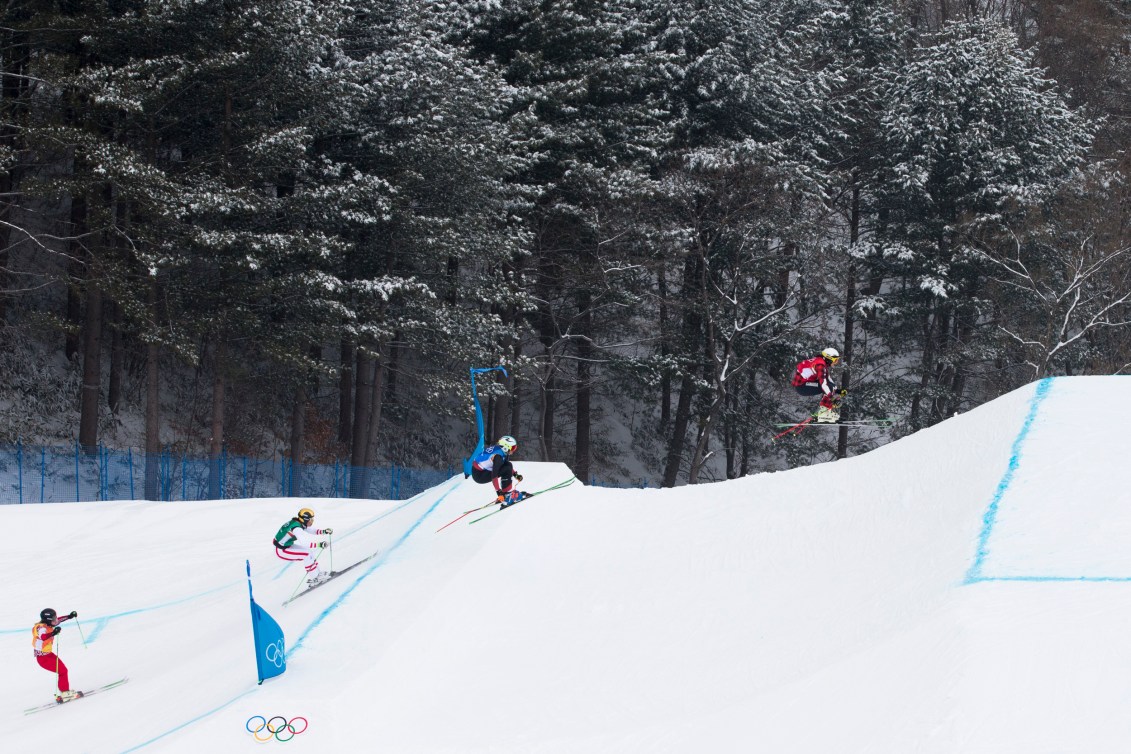
Navigating the course is not just a skills competition, but also a mental game.
“I am always very focused on the first thing I have to do,” explains two-time Olympian Kevin Drury. “[Before], I would get tied up with things further down the course, maybe things that made me nervous or things that I knew were super important. But then I would make mistakes early. Now I focus on the first move I have to do and then the rest just comes.”
What are the rules of ski cross?
Four athletes race each other down the course, with the goal of being the first one to cross the finish line.
To explain her sport to people who are unfamiliar, PyeongChang 2018 Olympian India Sherret has an example at the ready.
“I think the classic [example] is, ‘do you know what motocross is’? And usually the answer is yes. And I’m like, ‘well, I do that on skis,’” says Sherrett. “[Though] explaining it like that doesn’t really give a sense of the level of chaos that is involved sometimes.”
Having competitors compete elbow-to-elbow is one of the many unique aspects of ski cross.
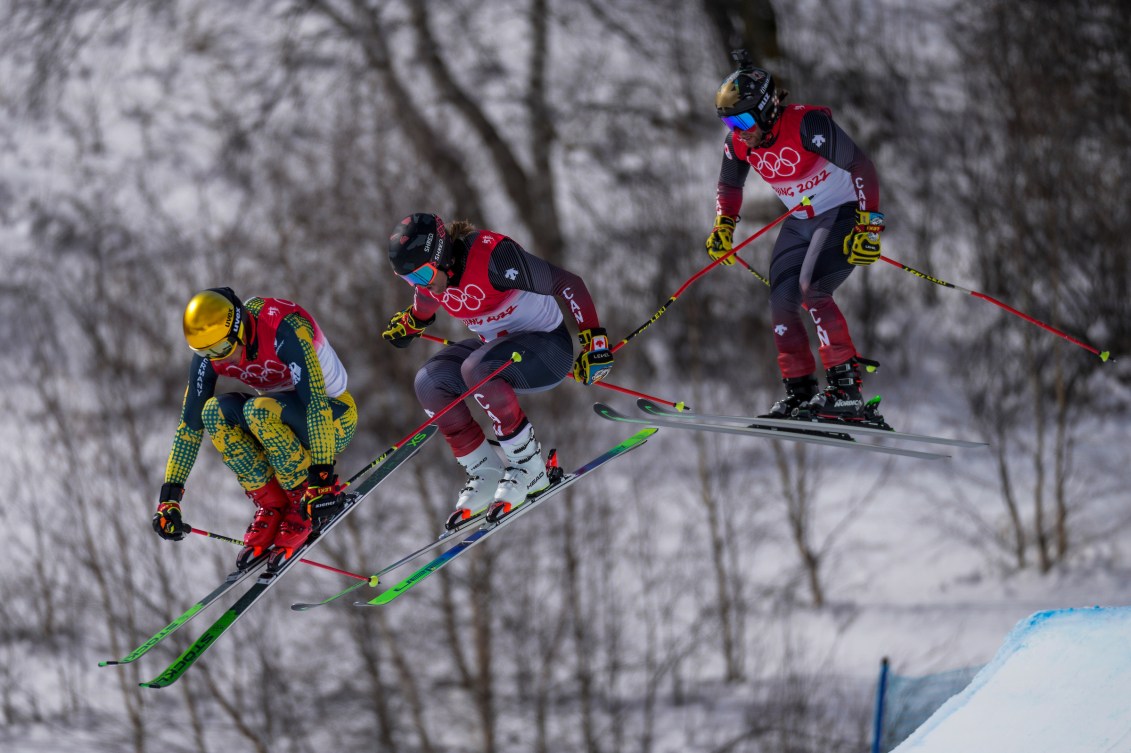
“There’s three guys right next to me, like, this is awesome,” says Drury. “Most people get scared, they’re like, ‘this is terrifying’. I’m flying off a jump and there’s a guy right here. I love that adrenaline rush.”
Being this close together, incidental contact is not only allowed, but expected. Though athletes can receive soccer-style penalty cards if the contact is deemed purposeful—like pushing or blocking a competitor. Receiving a yellow card results in being ranked last in their heat, while a red card disqualifies them from the competition entirely.
Results are determined by who crosses the finish line first, with their body, not skis or any other equipment. If multiple competitors don’t finish the race, their order is determined by how far down the course they made it.
How do ski cross competitions work at the Olympics?
At the Milano Cortina 2026 Olympic Winter Games, ski cross events will begin with a seeding round to sort all 32 competitors into elimination heats. Each skier will take a solo run through the course, with their time determining their elimination heat.
Each elimination heat will have four skiers going head-to-head, with the top two advancing to the next round. This repeats until the finals, which consists of a Small Final and Big Final.
In the Small Final, athletes will compete for 5th to 8th place while the top two from each semifinal face off in the Big Final for the medals.
Team Canada will compete in ski cross events at the Livigno Snow Park on February 20 and 21.
What can we expect from Team Canada at the Milano Cortina 2026 Olympic Winter Games?
Olympic quota spots for ski cross won’t be allocated until the qualification period ends on January 18, 2026. A country can qualify up to four men and four women. Canada is well positioned to earn the maximum number of quota spots. As for who will fill those spots, with a national team filled to the brim with Olympians, World Cup winners, and World Championship finalists, it will be a tight race to the top throughout the first part of the 2025-26 season.
Thompson, a veteran with three Olympics under her belt, sees this as a double edged sword.
“I’ve gone from being 18 years old and learning from my many awesome teammates, to now kind of being the most experienced,” she says. “I just know that I benefited so much from my former teammates so I try to give back as much as I can.”
“But they’re my competitors as well, right? And I know my teammates are the best in the world.”