Moguls 101: The ins and outs of the bumps and jumps

Team Canada has produced plenty of Olympic magic on the moguls hill in recent memory.
Jennifer Heil, Team Canada’s Chef de Mission for Milano Cortina 2026, won Canada’s first-ever medal in women’s moguls—a gold back at Turin 2006.
Alex Bilodeau famously won Canada’s first ever Olympic gold medal on home soil in the men’s moguls at Vancouver 2010 (and then successfully defended that gold four years later).
Who can forget the Dufour-Lapointe sisters—Justine (gold) and Chloé (silver)—sharing the podium at Sochi 2014? (Their older sister Maxime came just short of reaching that final.)
READ: A story of friendship: How the Dufour-Lapointe sisters support each other through highs and lows
And of course, there’s the living legend Mikaël Kingsbury, who’s been on the podium at the last three Olympics: silver in Sochi, gold at PyeongChang 2018, and silver at Beijing 2022.
In all, Canada has 11 Olympic medals in moguls, dating back to Jean-Luc Brassard’s gold at Lillehammer 1994. So maybe you’re feeling a bit late to the game in asking: hey, what exactly is moguls?
Fear not, we’ve got you covered.
So, hey, what exactly is moguls?
It’s a discipline of freestyle skiing that debuted as a demonstration sport at Calgary 1988, then became an official Olympic medal event at Albertville 1992.
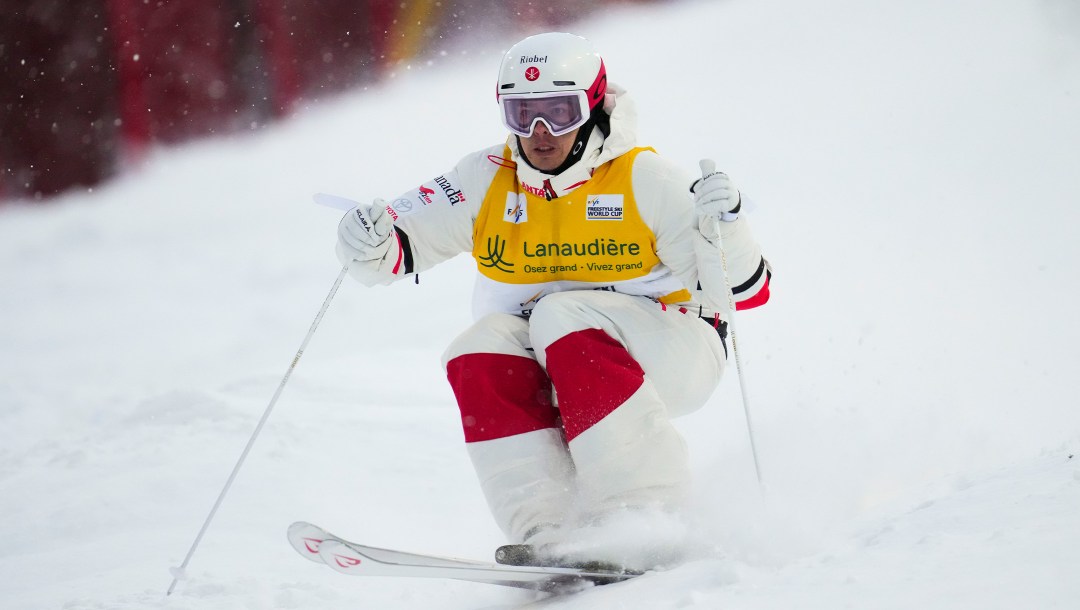
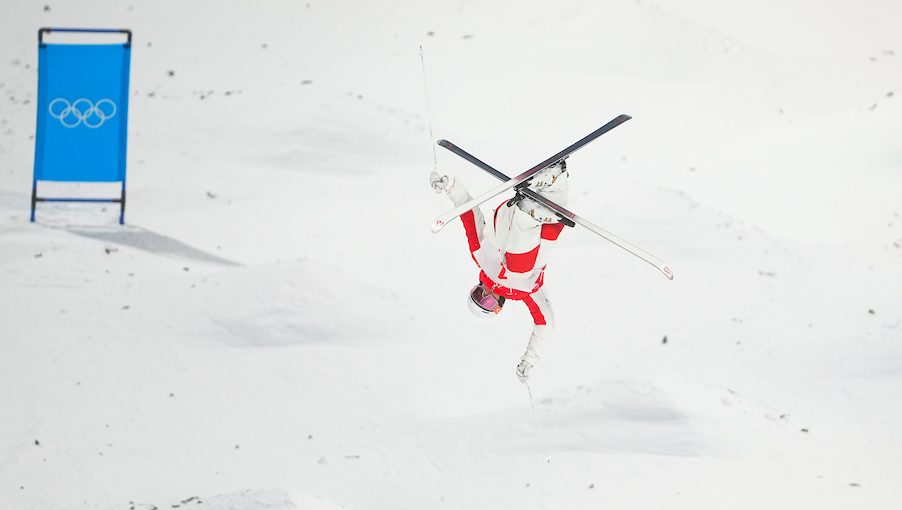
Skiers travel down a course of snow bumps, completing two aerial tricks along the way. So, if you’ve seen clips of skiers zipping super-fast with knees locked together while also extending and compressing themselves like an accordion—yeah, that’s moguls.
But the bumps aren’t just something to get through; the quality of a skier’s turns through the bumps (as determined by a panel of judges) makes up the majority of their score The quality and difficulty of their aerial tricks and their speed down the hill make up the rest of their score.
Which moguls events are taking place at Milano Cortina 2026?
The men’s and women’s moguls events will be on the program, as they have been since Albertville. But new to the Olympic Winter Games is dual moguls, in which two skiers compete directly against one another on parallel courses. The turns are still worth the most points, but speed and aerial tricks take on added importance.
For their part, some of Canada’s top moguls skiers are excited for the new event.
“I think I get more excited about duals and I feel less nervous when it’s dual,” says Kingsbury, who’s chasing a fourth Olympic medal. “There’s a bit more adrenaline in dual moguls because you have someone against you and you’re absolutely, sometimes, going all out.”
It’s the first time that moguls skiers will have a shot at two medals in the same Games. That’s helped light a fire for Maïa Schwinghammer, a 24-year-old from Saskatoon looking to compete in her first Olympics after winning moguls bronze at the 2025 FIS World Championships.
READ: Moguls skier Maia Schwinghammer is growing towards Milano Cortina 2026
“It’s going to be history making for us. So, it’s definitely something I want to take advantage of and put more emphasis in my training on those dual starts and that speed element of mogul skiing,” she says.
“I’m so excited. It’s so cool. We get to stay at the Games longer. It’s awesome. And especially with Jenn Heil as the Chef de Mission. I think it’s a really nice full circle moment for her too.”
What’s a moguls skier thinking at the start of a race?
Schwinghammer listens to music and tries to keep things light as her moment in the gate approaches.
“I try to really do some breathing and relax and focus on some keywords. I go through, okay, what are the elements of the course that I need to work on?” she says.
“But then when I really step into the start gate and I’m looking down my line, I try to let it go. I try to just be free, you know. Remind myself, just let the body move. The body knows what it knows how to do.”
It’s a similar routine for Elliot Vaillancourt, a 26-year-old from Drummondville, Que. who was world junior champion in dual moguls in 2019 and is also pursuing his first Olympic appearance.
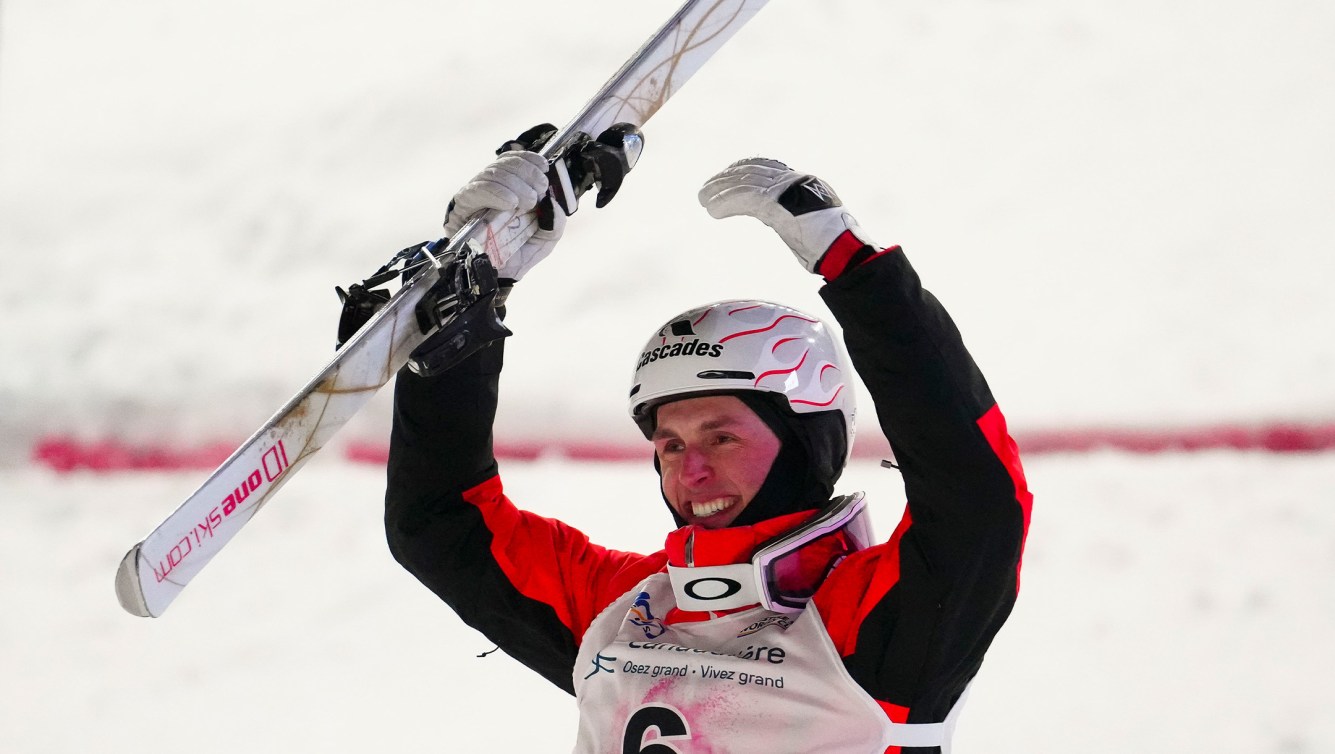
“This winter, I was mostly trying to just stay in the moment, feel your body. Just try to get out of your head,” he says. You’ve done the work, you know the course.
“Just stay in the present. Enjoy the moment. They say ‘3-2-1, go’ as a formality, but time only starts when you cross a laser beam. So, after the ‘go’, I always take a second or two and it’s like time kind of stops. It’s like, ‘All right, let’s go.’ Then you drop in.”
What should people know about moguls?
Vaillancourt has a clear message: not all moguls courses are created equal.
“I feel like sometimes non-skiers would think the snow is snow, regardless of cold or hot,” he says. “But also, the courses are so different from one another. Without training, if we have to go from one venue to another and just compete one run, there’s no way we can be this good.
“So the training is crucial, because the jumps are bigger, smaller, the bumps are quicker, faster, bigger, the snow changes, the course lights are different, the pitch is different, the rhythm of the bumps is different. It’s the addition of all those little changes that makes everything completely different from one course to another.”
READ: Great Team Canada Olympic moments in moguls
As if the sport weren’t already challenging enough, adjusting to the idiosyncrasies of different courses brings a whole other degree of difficulty.
“[I wish more people knew] just how athletic you have to be just to go down a moguls run,” says Louis David Chalifoux, a 23-year-old from Quebec City. “I mean, it’s easy to see the sport and ignore that, but it’s a very difficult sport, and everyone competing at the highest level like that is incredible right now.”
Chalifoux took up the sport after seeing Bilodeau claim that famous gold at Vancouver 2010. As he seeks his own Olympic moment, he’s just pleased to be part of a high point for moguls.
“The level of the World Cup tour is really, really high, the highest it’s ever been,” he says. “So many people being so good, it really pushes the sport, and it’s fun to be a part of it.”