Canada gears up for Olympic qualification tournament in women’s soccer

Canada’s long road back to the Olympic podium in women’s soccer begins this month in Texas.
That’s where the Concacaf W Championship takes place from November 27 to December 5. It features eight teams from North and Central America and the Caribbean vying for spots at the LA28 Olympic Games as well as the 2027 FIFA Women’s World Cup.
On Wednesday, Canada Soccer announced the 23 players on head coach Casey Stoney’s tournament roster. The squad, listed below, includes 14 players who were part of the Paris 2024 Olympic roster.
READ: Improbable journey in women’s soccer ends with heartbreak for Canada at Paris 2024
Nichelle Prince will join the team as a training player, while fellow Olympic veterans Vanessa Gilles and Jordyn Huitema are unavailable due to injury.
This competition will be Canada’s only chance to earn a spot in the next Olympic Games and Women’s World Cup. Read on for what to expect once the action kicks off.
What is the format of the Concacaf W Championship?
It’s a super quick single-elimination tournament, starting with the quarterfinals. Canada faces Panama on Saturday, Nov. 28 (1 p.m. ET / 11 a.m. PT). The United States vs. El Salvador, Jamaica vs. Costa Rica, and Mexico vs. Haiti are the other quarterfinal match-ups.
The winners of those four matches all qualify for next summer’s FIFA Women’s World Cup, which will take place June 24 to July 25, 2027 in Brazil.
There are also three Olympic berths on the line in this tournament. The United States is already in for LA28 as the host nation. That means that unless 78th-ranked El Salvador shocks everyone and beats the Americans in the quarterfinals, all four semifinalist squads are also headed to LA28.
In other words, a win over Panama is likely to send Canada to both the Women’s World Cup and the next Olympic Games. At the very least, it’ll send them to a semifinal match against either Mexico or Haiti.
How does Canada stack up at the Concacaf W Championship?
The Americans are the perennial favourites, as three-time defending champs of this competition. The USA sits No. 2 in the most recent world rankings, while Canada is at No. 9. The next Concacaf team is Mexico, at No. 28.
Meanwhile, Panama — Canada’s opponent in the all-important quarterfinal — is down at No. 54. So while the Canadians aren’t necessarily favoured to win the tournament, the hopes for securing World Cup and Olympic qualification are very strong.
What kind of momentum does Canada have?
It’s been a bit of a mixed bag in the past 12 months. The team has six wins (two of them in penalty shootouts) and five losses in 11 matches dating back to November 2025.
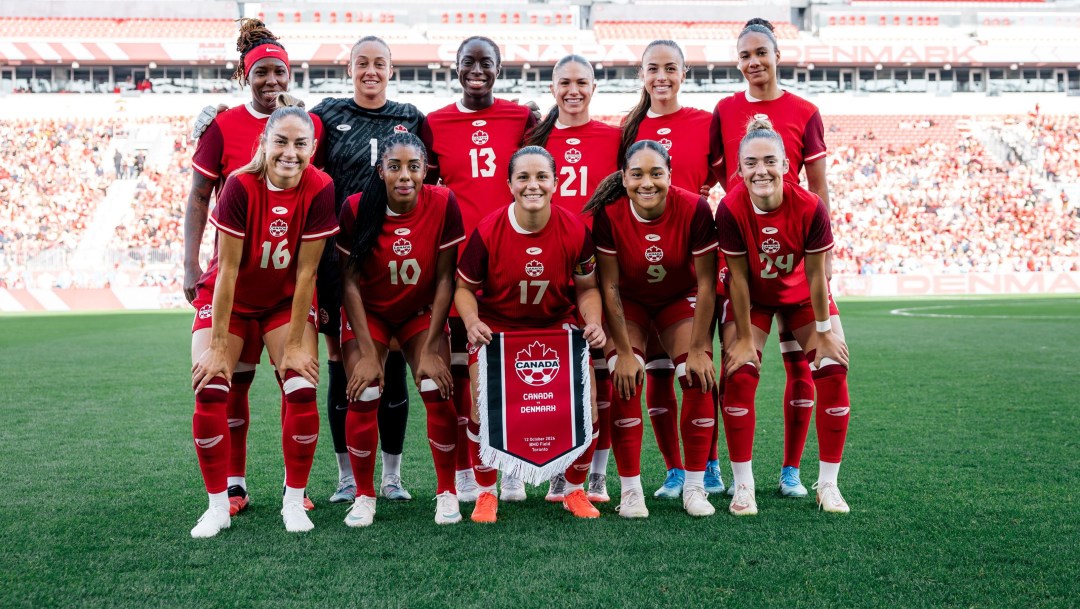
Most recently were a pair of friendly matches played in Montreal and Toronto in October. Canada played two very closely fought matches against Denmark, ranked No. 10 in the world, resulting in a 1-1 draw and a 4-3 loss.
What’s so special about this qualification cycle?
It’s the first World Cup and Olympic cycle since the Northern Super League began play in 2025. That league — Canada’s first professional women’s soccer league — was the brainchild of London 2012 hero Diana Matheson.
READ: Matheson goes for next big goal with key assist from Smith School of Business
The league is already paying dividends, with five roster members — Sabrina D’Angelo, Shelina Zadorsky, Kaylee Hunter, Marie-Yasmine Alidou, and Delaney Baie Pridham — currently playing in the NSL.
Most notable among them might be Hunter, an 18-year-old striker who just won the NSL Championship with AFC Toronto. She turned heads with a hat trick against France in the Round of 16 at this year’s FIFA Under-20 Women’s World Cup.
She joins 19-year-old Annabelle Chukwu and 22-year-old Olivia Smith as part of what could be a very dangerous attacking crew for years to come.
What other newcomers should we keep an eye on?
Emma Regan has been in the national team system for half her life, but this is her first shot in a big competition. The 26-year-old midfielder benefited from the NSL’s arrival, playing a key part for AFC Toronto in 2025 before moving to a USA-based team this year.
Élisabeth Tsé has played just two games for Canada thus far, but the 23-year-old from Quebec City will look to be part of the national team’s next generation of defenders.
Carly Wickenheiser is also a relative newcomer, with eight games for Canada under her belt. But the 29-year-old midfielder comes with immediate name recognition to most Canadians — yes, she’s related to hockey icon Hayley Wickenheiser (they’re cousins).
Team Canada Roster for 2026 Concacaf W Championship
Goalkeepers: Sabrina D’Angelo, Lysianne Proulx, Kailen Sheridan
Defenders: Kadeisha Buchanan, Gabrielle Carle, Élisabeth Tsé, Ashley Lawrence, Jayde Riviere, Jade Rose, Janine Sonis, Shelina Zadorsky
Midfielders: Marie-Yasmine Alidou, Simi Awujo, Jessie Fleming, Julia Grosso, Emma Regan, Carly Wickenheiser
Forwards: Annabelle Chukwu, Kaylee Hunter, Cloé Lacasse, Delaney Baie Pridham, Olivia Smith, Evelyne Viens